Showing posts with label Australia. Show all posts

Monday, 25 November 2019

Sickness Country video


From the album Abstract Vectoral Landscapes TQN-aut 7
video captured on East Alligator River (Erre), Kakadu National Park, Northern Territory, Australia.


scramble up from the track
in the breath of the heat on the wind
past the smoke of the fire
scrubby grass and the river is dry
butterflies, blackened tree
plateau, savannah, falls, and floodplain
pandanus spiralis
stones underfoot, the walk to the ridge

and there Myormu
waiting for me
sickness country
and in rock escarpment
in the deep past
Miyamiya 

and the camera phone
brow trickles waterfall sweat to the ground
from the mountain below
Google Earth, or a video drone 
as the ground is above
captures fatal painting photograph
the rainbow came through
tail lights and explosions below

and this sickness country
all that you can see
is what you’re told 
you can see [to see]
peripheral night 
soon after twilight 
flashes of light

when the sickness takes hold
nausea, vomiting, appetite loss
dehydration, confusion
cells degraded by autophagy
bone marrow syndrome
cutaneous blisters ulcers
sweat glands atrophy
DNA clustered damage takes hold

somewhere…


[...over the rainbow]

Saturday, 25 November 2017

SUBCINEMA Melbourne screening 18 December 2017

SUBCINEMA
Steven Ball
8pm 18 December 2017
Arena Project Space
2 Kerr Street
Fitzroy 3065
Australia

Screening Notes

Steven Ball has been working in audio-visual media since the early 1980s. In the late 1980s he accidentally migrated to Melbourne, Australia, where he continued his practice making a number of film, video and sound and installation works, as well as engaging in various curatorial, administrative, teaching and writing activities, the most significant of which was several year’s deep involvement with the Melbourne Super 8 Film Group. He returned to the UK in 2000, and since 2003 has been Research Fellow in Fine Art at Central Saint Martins, where he has been instrumental in establishing the British Artists’ Film and Video Study Collection.

Since returning to the UK his projects have included Deep Water Weban audio-visual installation and online collaborative work with John Conomos at Furtherfield Gallery, London (2016); Film of the Same Name (video, 2015) with Philip Sanderson; Concrete Heart Land (video, 2014) with Rastko Novakovic; the screening exhibition Figuring Landscapes, which toured the UK and Australia (artist and co-curator 2008-2010). His publications include ‘Expanded Cinema: Art Performance Film’, Tate Publishing, (co-editor and author, 2011) and writing for journals such as Moving Image Review and Art Journal (MIRAJ) and Senses of Cinema.

Most recently he has concentrated on music projects, as a member of Storm Bugs (post-punk DIY outfit since 1978) with Philip Sanderson recently releasing ‘Certified Original and Vintage Fakes’ (CD and download, Snatch Tapes, 2017), and his new solo album 'subsongs.' (CD and download, Linear Obsessional Recordings, 2017), which has been described by Radio Free Midwich as “The missing link between reductionist improv and the intimate breathy song cycles of a Robert Wyatt.”

This screening brings together a selection of film and video works made over a span of some twenty years. The work covers a range of territory and approaches, in particular concerning spatiality and landscape in Australia, the UK, and elsewhere, often through the filter of his relationship to what might be thought of as a post-colonial position. The works integrate structural and materialist techniques, they are variously essayistic, experimental, rhythmically abstracted, and occasionally immersive.


Programme

Periscope 180°
(super 8, 17 min, Australia, 1992)
The title indicates the scopic and conceptual topography of the film. The film starts in Fremantle, West Australia, with nautical references (seascapes, masts, lighthouses). The second part moves in East Gippsland, Victoria, alternating indistinct images of beach, sea and sky with black and white footage of fishermen on a beach. Taking up notions from Deleuze & Guattarian deterritorialisation, and including lines taken from Stanley Kramer's 1959 film On the Beach, the voice over narration resounds with ironical autobiographical suggestiveness, “...he’s English and he’s here on some scientific job, or was it geographic? What does he do exactly?”, becoming a poetic speculation on the uncertainty of migration towards a nomadic condition of continual departure and the paradox of return: the refrain. The third and final part in aerial transit, an arrival denied by the film's ending.


The Ground, the Sky, and the Island
(digital video, 8 min, UK, 2008)
This video reworks photographs, super 8 film, sound and anecdotal text from a series of bush and outback locations across Australia during the 1990s. It takes the form of extracts from an imagined first-person journal, layered over extruded experiments with composition and movement constructing a synthetic shifting landscape. Moving through discrete but related sections, the abstracted view shifts vertically through 90°, between the closeness of the local, the ground, and the claustrophobia of the distant colonizing horizon. As it travels east from the South Australian desert, through bush, tablelands and rocky range, the video becomes a subjective essayistic meditation, in absentia, on being in the landscape, the problem of attempting to reproduce these landscapes and the uncertainty of their representation. At its inconclusion we arrive on K'gari (Fraser Island off the coast of Queensland) where we reach the edge of the known world, a space being made in an open future.


However, the Autodidact
(super 8, 17 min, Australia, 1994)
frame enlargements by Arthur Cantril
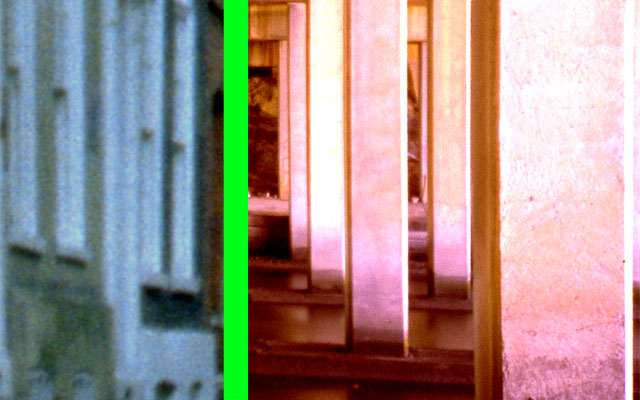
From my small back room in Elwood in 1994, with super 8 camera taking revenge on the helicopters which I was convinced might have been spying on me; not paranoid, just healthy suspiciousness. The film was then reshot through several generations of just out-of-date super 8 film given to me by Marie Craven. The variations of grain and colour determined by the stock, which included Kodachrome, Agfa Moviechrome, and Ektachome. I devised an editing structure determined by the ideas that perception of the 'present moment' lasts for around three seconds as theorised in The Dimension of the Present Moment by Miroslav Holub. The soundtrack is constructed using a similar schema, made entirely of extracts from quarter-inch tapes found in a second-hand shop, included a teach-yourself-French tape, which inspired the title.


The Defenestrascope
(digital video, 6 min, UK, 2003)
Throwing the view through windows from monumental towers in contemporary medieval European city and town. This eccentric exploration of urbanised space revolves around a setting of the traditional 16th century Norfolk song Go from the Window. The melody reconstructed from an ensemble of samples from a variety of sources, determined the choice of a series of views from 'the window' and elsewhere. Framed by a fragmented clapping rhyme it echoes Music Hall and anthropological folk recordings in a neo-rococo vaudevillian romp for the surveillance age.


Aboriginal Myths of South London
(digital video, 10 min, UK, 2010)
Aboriginal Myths of South London adapts world views associated with indigenous people of Oceania to an interpretation of the space and social history of places in South London. As the first manifestation of the project, this video is presented as its prelude and explores New Kent Road, a major road close to the artist’s home. This application of attitudes to the status of the dead and human relationship to the ground, becomes a materialist alternative to the concept of the genius loci and the familiar. The approach is measured and austere, employing an arrangement of animated photographs and voice texts that becomes a poetic essay.


Harmonic Three Three
(super 8, 23 min, Australia, 1991)
frame enlargement by Arthur Cantrill
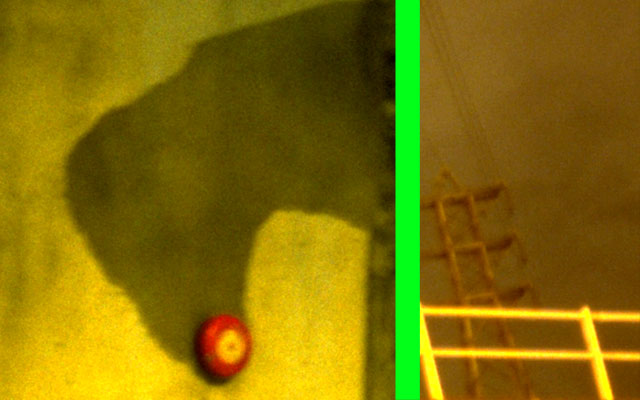
The originating super 8 film was shot on Fraser Island off the coast of Queensland. The relatively firm sand of the beach provides one of the main roads on the island as the interior tracks become unpassable due to the loose sand. As we drove north up the eastern side of the Island we came across the rusting hulk of a ship wreck; one of the more accessible of many such wrecks dotted around the Australian coastline. The former luxury New Zealand trans-Tasman liner Maheno was sold to Japan for scrap metal. On July 9th, 1935, while being towed north by the Oonah, it hit unseasonal cyclonic conditions off Fraser Island. The tow rope snapped and it was driven ashore on the 19th July. It remains there to this day, slowly disintegrating in the salty tropical sea water. I reshot subsequent generations of the film on super 8, off the screen, concentrating on the abstraction afforded by the increasing graininess and contrast of each generation, concerned with the grain, the light, or lack of it, and the degradation of visual information. Much of the film is dark, unreadable, ghostly, shadowy. Occasionally orange light bursts through the silhouetted contrasty skeletal image of the wreck. I used all of the film shot in the re-re-re-reshooting in the final version, which results in long dark sections throughout the film. The experience of watching the film is dense, intense, quite dramatic. This is in part due to the dark ambience of the soundtrack, which was composed entirely from a recording of waves on a beach, slowed to a fraction of its original speed, employing varispeed manipulation, delay and phase effects, which were all improvised ‘live' to tape while watching the film.


81 mins total

Monday, 6 September 2010

some September screenings

Inanimatismus

Inanimatismus screens at:
• Ukrainian Art Festival, Koktebel, Ukraine,
7 - 9 September;
• Future Proof, Marseille Project Gallery, France,
Saturday 18 September;
Stew Gallery, Norwich, UK,
Wednesday 29 September
.
These screenings are part of One Minute vol 4

The Ground, the Sky, and the Island screens at:
Alchemy Film and Moving Image Festival
Hawick, Scottish Borders,
Sunday 12 September;


Direct Language screens at:
cogcollective at The BAck doOR
Melbourne, Australia
Saturday 25 September. 

Thursday, 13 August 2009

Unspoken Word

I’m currently starting to develop a couple of small projects and to each of them, in one way or another, spoken word is central. That is to say, each will, in one way or another, be a setting of recordings of spoken words. Whether the setting consists of being placed in a context, involving simple editing or more complex manipulation, will depend in degree on the parameters of the project, much of which has yet to be decided let alone realised. Some of the outcomes will be posted here.

I have been thinking about ways in which the spoken word has been used in sound poetry and sound art as well as in pop, experimental and electronic music. I have also been trawling through some old work and remembering how I have experimented with the sound of speech in the past. I thought it might be interesting to compile four pieces I made around ten years ago into a little downloadable collection, a ‘mini-album’, if you like. They are all rather rudimentary and rough experiments with digital sound editing and collage, and it’s interesting, while perhaps not unsurprising how throughout they play within the time-honoured avant concrete conventions of the aesthetics of repetition and the logic of fragmentation. I’m not so sure that’s how the new work will proceed, but we shall see. Or rather, we shall hear.

Click the cover image above to download a zipped file (59.6Mb) of the 'mini-album' (
320kpbs mp3 files) or play below.

Track info:
1. Say Zero (5:14, 2000)


This track came out of experiments with a CD containing demos of recordings of actors’ produced by a voice-over agency. The actors’ performances conformed to the conventions for advertisements, information films, radio announcements and so on. They were by turn upbeat, sing-songy, serious, conversational, exactly what you might expect. As this was Australia, they also had that informal casual Australian chumminess. I broke the voices down to phonemes, cut, pasted and created insistent, breathy, stammers of rhythm; some sounded disturbed, quietly obsessed or climactic. This is an extended version of the one minute piece made for Colin Fallows’s Audio Research Editions CD Zero. More about that here.

2. I Was Bugging (4:10, 1998)


Going around the internet at this time was an audio file that purported to be an answering machine message relating a first person account of an episode of casual sex with a stranger, in some detail. At that time such revelations were more rare than they have now become, at a time before people felt it necessary to regale the world with their most intimate thoughts on the web. What was most interesting about the recording though, was not so much the sordid details but the excited relish of the person divulging the event, apparently breathless with gossip about themselves! A slightly slowed down (to obfuscate the gender) and channel separated version of the recording starts the piece, followed by a squelchy spanking rhythmic track made entirely from samples of the recording.

3. The Shape That Has Held Me (5:21, 2000)

Australian visual poet and super 8 filmmaker pete spence sent me a copy of a poem, which surprised me for being a sort of gently surreal existential piece. Surprising because pete’s work is usually characterised by elegant cut-up image-text visual poetry. But this is no straight forward nihilism of being that spence has penned, there is great humour in word play in lines such as "I am a notion I search always to find, like a small lantern of fur sleeping at the foot of my bed, which I carefully avoid waking when I enter the immense collapse of my room". In retrospect my reading of it is rather earnest. Like Say Zero it is mostly rhythmic fractured fragments of the sound of my voice, which has a certain squelchy vivacity, occasionally it breaks into legibility.

4. At Five in the Afternoon - with Lee Smith (13:29, 1999)

This was a collaboration with Lee Smith and it is his very distinctive voice that introduces and sets the tone for this setting of a poem by Federico García Lorca. It was made for a film by Lee that took the poem’s title and we experimented with a number of editing techniques to produce a musical cadence from his reading, and used recording techniques such as shouting from the other side of the room. There are long sections of the sound of traffic, recorded outside the front door of my house (Victoria Street in Footscray could get busy), and the voices from Say Zero make another appearance. I had started to work with Lee on a few sound/music pieces. As well as making wonderful experimental super 8 and 16mm films, Lee was also a guitarist and had a passion for all kinds of music. We were at one point working on a bizarre version of Donovan’s song Season of the Witch, which is alas destined to remain unfinished as I left Australia in 2000 and Lee sadly died this time last year. This is for him.


** Update: now available on SoundCloud
http://soundcloud.com/steven-ball/sets/unspoken-word/


Sunday, 10 May 2009

Tuesday, 10 February 2009

The Ground, the Sky, and the Island


This video reworks photographs, super 8 film, sound and anecdotal text from a series of bush and outback locations across Australia during the 1990s. It takes the form of extracts from an imagined first person journal, layered over extruded experiments with composition and movement constructing a synthetic shifting landscape. Moving through discrete but related sections, the abstracted view shifts vertically through 90 degrees between the closeness of the local, the ground, and the claustrophobia of the distant colonizing horizon. As it travels east from the South Australian desert, through bush, tablelands and rocky range, the video becomes a subjective essayistic meditation, in absentia, on being in the landscape, the problem of attempting to reproduce these landscapes and the uncertainty of their representation. At its inconclusion we arrive on K'gari (Fraser Island off the coast of Queensland) where we reach the edge of the known world, a space being made in an open future.

The Ground, the Sky, and the Island was made for Figuring Landscapes

Wednesday, 4 February 2009

Figuring Landscapes

Artists’ film and video on themes of landscape from Australia and the UK

This weekend at Tate Modern:
http://www.figuringlandscapes.co.uk
http://www.tate.org.uk/modern/eventseducation/film/figuringlandscapes.htm

Tuesday, 11 November 2008

Horizons and Centres

If my blog writing has been a little skimpy the last few months it's because I've been incredibly busy with other things. Two of those things reach some kind of fruition in the next few weeks: two separate curatorial collaborations, both involve Australian artists.

Transcentric, an exhibition at Central St Martins's Lethaby Gallery, a collaboration with RMIT in Melbourne on the theme of the urban centre, opens next week on Monday 17 November.

Figuring Landscapes, a touring screening programme of Australian and UK moving image works on the theme of landscape, has its first public exhibition at ArtSway in the New Forest on Monday 24 November.

Click on the links for details - I'm too busy to write more!


Friday, 15 August 2008

Microscape


The Big Carpet Snake came through this country long ago in the Dreamtime. At that time the sea was not here (and) the land went all the way to the mainland... On his way down from the north, his body made the channel between Hinchinbrook Island and the mainland. The big snake came down the Herbert River, went out to sea and broke up leaving parts of his backbone which are the Palm Islands and his head which is Magnetic Island. The tail of his body is at Halifax Bay.
- Wulgurukaba people, Yunbenun (Magnetic Island), Queensland, Australia

Friday, 1 August 2008

Personal Electronics Dossier


On Saturday I will be performing Personal Electronics as part of the series of moving image performances Intermission: Who is Miss Roder being presented by the Melbourne International Film Festival in Australia. The performance is concerned with ideas around the notion of paranoia and was partly inspired by reports that instances of what one might call ‘everyday paranoia’ are on the increase. My subject expanded when I discovered phenomena such as gang stalking (people stalked or harassed in public by gangs of strangers, on the street, in cars, etc.), electronic harassment using lasers and voice to skull technology (people attacked in their own homes by remote lasers or hearing voices inside their own heads transmitted using technology that by-passes the ears), where individuals claim to be long-term victims of attacks by perpetrators unknown. There are many websites dedicated to reports about these attacks, speculation as to who the perpetrators (known as ‘perps’) may be and their motivation, as well as calls to government to introduce legislation against the practice (which might be optimistic as other sites suggest that governments themselves might be instigating much of this activity to intimidate and discredit personae non gratae).

There are also many videos on YouTube and Google Video made by the victims of these attacks. My performance will consist largely of extracts from online videos uploaded by victims with live voice performance of text extracted from videos and reports, including anonymous contributions to the performance gathered up to the day of the performance via a form on my website. The live voice will be performed by reciting recordings of extracts of these texts, played back in random shuffle mode on an iPod through earphones, in effect I will be repeating the voices in my own head. This will be presented without commentary.

The unasked questions might be whether this is an absurd extreme of the kind of everyday anxiety and paranoia that most people are familiar with, or whether the victims’ experiences are evidence that much paranoia points to justified concerns about organised activities being perpetrated potentially against all individuals.


Here is a link to some of the information available online as a research dossier of material for Personal Electronics:
http://delicious.com/spherical_object/personalelectronics

Monday, 21 July 2008

Attitude


click on image for QuickTime movie (9.7Mb)

Wednesday, 9 July 2008

Work in Australia

With the recession biting at our heels in the UK it seems that many are considering fleeing to distant shores with the promise of a better life. According to this article certainly ‘white collar’ Australians in the UK seem to be cutting their losses and making the trip home believing “…that Australia, with its strong economy and buoyant jobs market, is the best place to ride out the credit crunch.” And then the other day on the tube I glanced over the shoulder of someone reading one of those nasty free papers; what caught my eye was an advert suggesting that the reader might “work in Oz” and gave this MySpace page. Was this a new attempt to lure Poms downunder to a life of endless barbeques on endless beaches, living in the shadow of Uluru or Sydney Opera House or any number of other clichéd icons of the ‘Australian lifestyle’? Well yes and no. Rather than an update on the White Australia Policy it is in fact simply encouraging young adults to take a working holiday in the country, itself of course frequently a backdoor to residency. In trying to debunk some of the old clichés the MySpace page constructs another image of Australia as the gap year rite of passage of choice.

Anyway this was not intended to be a deconstruction of contemporary representations of Australian culture, you’ll have to wait a little longer for that one, but to mention that I will be presenting some work in Australia later this month in Sydney and Melbourne in early August:

Loose Space and Circular Time
- a non-chronological retrospective of a selection of film and video works made between 1991 and 2008.
7.30pm, Friday 25 July, Teaching and Learning Cinema, SYDNEY (a bar), 302 Cleveland Street, Surry Hills, Sydney

Personal Electronics
- a video/spoken word performance
10pm, Saturday 2 August, Intermission, Melbourne International Film Festival, Fortyfive Downstairs, 45 Flinders Lane, Melbourne

Two days later we travel out of Melbourne to catch the cogcollective screening
Intimate Journeys
curated by Lynn Loo
7pm, Monday 4 August at A Perfect Drop, 5 Howe Street, Daylesford, Victoria.

Tuesday, 22 April 2008

Rolled Up/Rolled Out

Rolled Up/Rolled Out
20:00, Monday 28 April, 2008
Resonance 104.4FM


Produced and presented by Steven Ball, this programme will present Breath: Polymers and Pneumatics, a breathing performance by Australian artist Irene Barberis specially recorded in Australia for Resonance FM alongside work by London-based artists featured in the Melbourne exhibition Rolled Up/Rolled Out including Riccardo Iacono, Tina Keane, William Raban, Anne Tallentire and John Wynne.

Rolled Up/Rolled Out is part of a collaborative project between the University of the Arts London and Royal Melbourne Institute of Technology exploring the urban centre within and between the two cities. The Centres Project brings together two centres of Fine Art research, each central to their respective cities; within the complex flow of forces of an urban hub, each institution simultaneously responds and contributes to their cities’ stimuli.

Curated by Irene Barberis (RMIT) and currently on exhibition in Melbourne, Rolled Up/Rolled Out is concerned with how the production of art in global cities is responding and contributing to the intensification and expansion of cultural flows in globalization, providing a snapshot of the diverse practices that emerge through the common experience of contemporary urban space.

**Update: the show is here for anyone who missed it.


Saturday, 15 March 2008

m-dot.report


m-dot.report, 6:02, 1991

A recently rediscovered video that has never been publicly screened, until now.

Tuesday, 22 January 2008

Here We Are Then

In cinema, activity contained by narrative framing can hint at a universe beyond the local narrative as an ellipse often occurring at The End. In Chekhov (the Russian writer to whom Maeve tells me she has formed an attachment) characters inhabit clearly defined places, situated in a kind of pre-cinematic spatial mise en scene, place is key to their narrative form. There is this same tension in these paintings as their contained form and arrested energy fixes the temporal activity of painting in dimensions inside and outside the boxes.

Here we are then, first with 43 small polyglottous paintings. Small strokes inscribe
stories, a number of occasions coexist in one pictorial space just as a place that can be described or named exists only when a number of temporalities have occupied it. In these paintings multiple, sometimes repetitive, actions and movements describe a spatial index, the body and movement both within and beyond the frame: activity is occupation within borders colonised by haptic abstraction.

There are qualities here that I remember from Maeve’s films in the nineties when we were both active in the Melbourne Super 8 Film Group. Films like Tawdry Sass (1996), incised and painted skinny film, in effect not unlike some of these paintings. A voice on its soundtrack offers a clue describing “… a symbolic conquest of some kind of room’s regular boundaries”. Scrammy and the Blowflies (1995), made for the Bush Studies project of super 8 film based on Barbara Baynton’s short stories, is perhaps the closest Maeve comes to conventional ‘narrative’, expressing claustrophobia born out of containment, wherein, given a voice, Scrammy plots escape from his imprisoning hut. Then the film Out of Place (1991) is alive with non-human subjectivity occupying a carefully defined macro world. At 52 minutes the film is long by most super 8 standards, but doesn’t conform to the familiar avant-garde durational mode of the heroic internalised temporal subjectivity; rather it presents spatially related subjectivities, coexisting in some interstitial place ‘out there’.


And now we are here, larger paintings with cinematic titles like Rear Window and Andalusian Slit (recalling Hitchcock and Buñuel, both of course occasional collaborators with Salvador Dali); feature-length with bold shapes and dissected space, like a floor plan of wheelchair-imprisoned voyeur James Stewart’s apartment, but the window here seems less suited to voyeurism, more a sinister opaque dark barrier threatening to block the view. In Maeve’s ‘Andalusian’ painting the cinematic icon of the dissected eye has been transformed into something like a danger sign through an abstraction of composition, or a diagram in which the razor has become a stake or a rod. I am reminded that surrealism thrives in that most dangerously mundane zone of the uncanny in the quotidian.


The relationship between titles with quite specific references and formally quite abstract paintings, is deliberate and carefully considered, not an after thought but as a way of complementing the works. The title of Firs on Stage, with Locked Doors comes from Maeve’s interest in Chekhov’s The Cherry Orchard: the central round ‘stage’ of the painting seems deserted and deforested, a bleak greyness hemmed in, taunted perhaps, by the bustling world beyond its boundary. The titles suggest that abstract painting is not just some kind of ineffable expression, but part of a complex visual vocabulary, a spatial narrative extending in many directions.

Here We Are Then recent paintings and works on paper by Maeve Woods is at Watters Gallery, Sydney, Australia, 5 February to 1 March, 2008

images top to bottom:
Andalusian Slit
- 2006, oil on cotton duck, 122 x 122cm
Rear Window - 2006, oil on cotton duck, 152 x 122cm
Firs On Stage, With Doors Locked
- 2007, oil on cotton duck, 122 x 122cm

Monday, 14 January 2008

Off Off On


Off Off On, 4:08, 1992

Sorting through some tapes I came across a video copy of a super 8 film I made in 1992 when I was living in Melbourne, Australia. I'm taken aback to realise not only that the film was made nearly 16 years ago, but also that it is now nearly 20 years since I accidentally migrated to Australia.

But the text seems to concern a situation in a past more distant past:
after the crash, Easter 1979, in the flat, travelling, going nowhere fast…
from 13 years earlier, and then
the lapse begins at breakfast, the cup overturned on the table…

References to, or reproductions of the past are often the present in disguise, such as is the case in historical dramas and allegory.

Images from distorted photocopies of limbs, night-light streets shot on grainy fast black and white super 8, full of claustrophobia resonant with the melancholy and depression of the time it was made.

At the time however, it wa s a remix of Paul Virilio, (‘speed’, which is actually a reference to velocity, not amphetamines, give the game away), I am riffing on ‘The Aesthetics of Disappearance

From this distance and time it is possible to view the film with both familiarity and detachment, not so much as though it were made by someone else, more that when I made it I was someone else, which of course I was. So now it seems to be an odd mix of the personal, claustrophobia and their relationship to speed, history, distance and the production of appearances.

1979, 1992, 2008


Off Off On, 4:08, 1992

Sorting through some tapes I came across a video copy of a super 8 film I made in 1992 when I was living in Melbourne, Australia. I'm taken aback to realise not only that the film was made nearly 16 years ago, but also that it is now nearly 20 years since I accidentally migrated to Australia.

But the text seems to concern a situation in a past more distant than 1992:
...after the crash, Easter 1979, in the flat, travelling, going nowhere fast…
13 years earlier then, perhaps a domestic situation:
...the lapse occurs at breakfast, the cup dropped and overturned on the table…

References to, or reproductions of the past are often the present in disguise, such as is the case in historical dramas and allegory. Images from distorted photocopies of limbs, night-light streets shot on grainy fast black and white super 8, full of claustrophobia resonant with the melancholy and depression of the time it was made. This film is more about 1992 than 1979.

At the time however, it was a remix of Paul Virilio, (‘speed’, which is actually a reference to velocity, not amphetamines, gives the game away), I am riffing on ‘The Aesthetics of Disappearance’.

From this distance and time it is possible for me to view the film with both familiarity and detachment, not so much as though it were made by someone else, more that when I made it I was someone else, of course I was. So now it seems to be a cryptic mix of the personal, claustrophobia and their relationship to speed, history, distance and the production of appearances.

Sunday, 28 January 2007

Night-light


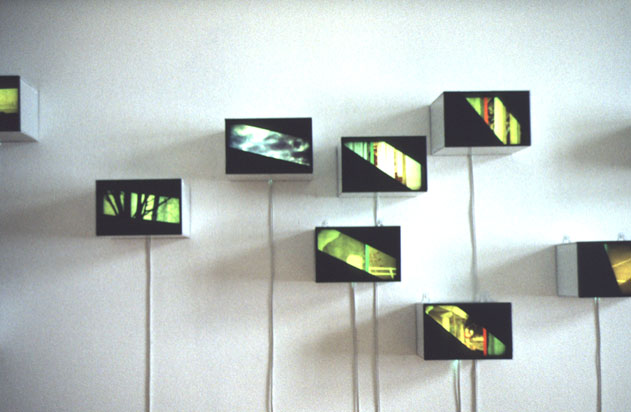
In 1999 I had an exhibition in Melbourne, Australia. The work consisted of 20 small light boxes (10 x 15 x 15cm) arranged on the wall over an area of approximately 400cm wide by 55cm high. A photographic image was set 10cm back in each light box with a mask on the front of the box forming an angled aperture that allowed the viewer a restricted view of the image and, by getting close and peering inside the box, they might, more or less see the entire image. So this was partly about establishing a spatial relationship between the viewer and the work. Another spatial dynamic was also at work. The photographs montaged in the images came from two sources. One set of photos was taken in London in 1995 when I returned to London for six months after having lived in Australia for seven years. The rest were taken a while after my return to Australia around the west of the city of Melbourne in 1998. The common factor in these two sets of images is that they were all shot at night with long exposures. Some of the Melbourne photos were shot in almost complete darkness, something that might not be quite so possible in London with its high levels of nocturnal ambient light.

The London photos were shot around the City of London, London Bridge and Borough. As I was walking home from Borough Market today through the Weston Street tunnel, under the Victorian viaduct that carries trains as far as New Cross or Deptford or thereabouts, recognising the brickwork of the tunnel from some of the photos I took 12 or so years ago. 12 years later I am living close to where some of the photos were taken, I thought of them as a link both backwards and forwards through space and time.

Night-light was exhibited at Westspace, Footscray, Melbourne, Australia, 13 March – 17 April 1999