Sunday, 25 February 2007

Daydream Workshop

Snow Factory Quicktime Movie 53 secs, 6.4Mb
Copenhagen, 25th February 2007

Saturday, 10 February 2007

Reinterpretationing


During the 1970s in this little known eastern European state, extreme suppression of freedom of speech took an unusual turn, but the way protesters overcame it was even more unusual. Protest was allowed but there were extreme restrictions on what words and form of words could be used in protests. Gradually the restrictions became so comprehensive that protest became all but meaningless. Protesters took matters into their own hands however and started to create banners with apparently obscure pictograms made up of typographic text. They effectively invented a new language which, while having its roots in underground resistance quickly became widely understood among mainstream society. In the letter of the law the authorities could do nothing as the protesters weren’t actually doing anything illegal. The images on the placards refer to particular issues, above for example you can see anti-nuclear weapon and anti death penalty placards. If the images look uncannily like concrete or visual poetry such as the work of Peter Finch, John Furnival or Bob Cobbing.

(images from the Sackner Archives of Concrete and Visual Poetry)

This is no surprise as the use of this form of placard was developed by a number of young artists with strong links to the Fluxus movement.
Concrete and visual poetry invited us to question and redefine and renegotiate the relationship of the word, punctuation, the letter and as a consequence language, to meaning, foregrounding punning and visuality, in the politics of poetry and visual language. Now this strategy was being employed in the in the street in the politics of protest and free speech...

Or at least that’s what I’d rather hoped was the case, but these are not documentary photographs but the work of Jens Ullrich whose doctored newspaper photos of protests are part of the Media Burn show on for another week or so at Tate Modern. The Tate website tells us that “...there is a sense of futility in the bearing of placards emblazoned with meaningless signs. However, some fundamental message survives, conveyed in the protesters’ facial expressions. For Ullrich, there are parallels between the protesters in these images and the role of the artist, a struggle to be understood and to make sense of the world around them.” Hmmm, really? While Media Burn makes a fairish stab at exploring “the boundaries between art, politics, protest and the media” Tate’s record of dealing with ‘political’ art has been less than distinguished, remember that this is the same institution that censored John Latham.

Sunday, 28 January 2007

Night-light


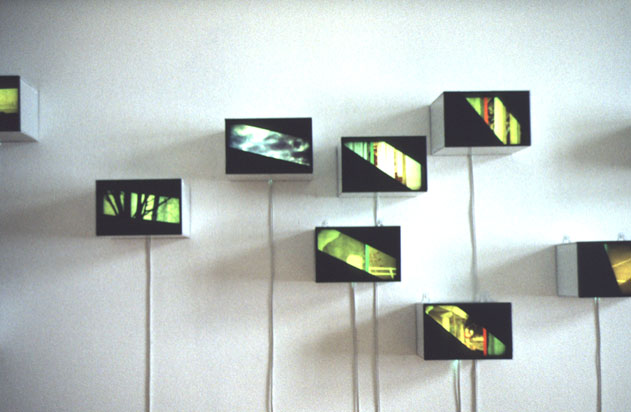
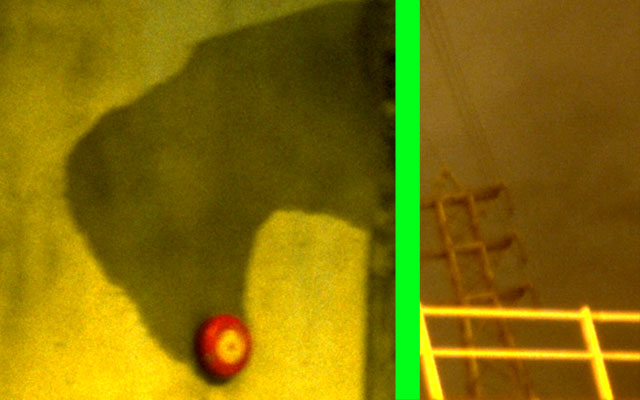
In 1999 I had an exhibition in Melbourne, Australia. The work consisted of 20 small light boxes (10 x 15 x 15cm) arranged on the wall over an area of approximately 400cm wide by 55cm high. A photographic image was set 10cm back in each light box with a mask on the front of the box forming an angled aperture that allowed the viewer a restricted view of the image and, by getting close and peering inside the box, they might, more or less see the entire image. So this was partly about establishing a spatial relationship between the viewer and the work. Another spatial dynamic was also at work. The photographs montaged in the images came from two sources. One set of photos was taken in London in 1995 when I returned to London for six months after having lived in Australia for seven years. The rest were taken a while after my return to Australia around the west of the city of Melbourne in 1998. The common factor in these two sets of images is that they were all shot at night with long exposures. Some of the Melbourne photos were shot in almost complete darkness, something that might not be quite so possible in London with its high levels of nocturnal ambient light.
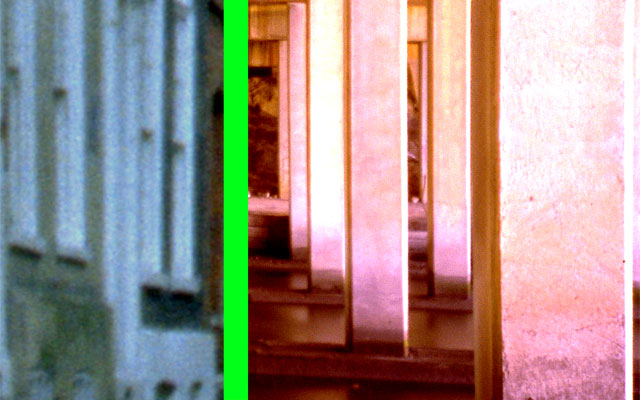
The London photos were shot around the City of London, London Bridge and Borough. As I was walking home from Borough Market today through the Weston Street tunnel, under the Victorian viaduct that carries trains as far as New Cross or Deptford or thereabouts, recognising the brickwork of the tunnel from some of the photos I took 12 or so years ago. 12 years later I am living close to where some of the photos were taken, I thought of them as a link both backwards and forwards through space and time.

Night-light was exhibited at Westspace, Footscray, Melbourne, Australia, 13 March – 17 April 1999

Thursday, 25 January 2007

"...hello?"

I'm on the Number One…


...at the Elephant...


...no at the traffic lights...


...by the station....


...no I'm still at the bus stop... he's letting more people on...